90 or 120 minutes · 3–5 players · System-neutral
The Cartographer's Last Door
A new door appears on a finished map. Its cartographer went through yesterday; today the map begins erasing the roads behind him.
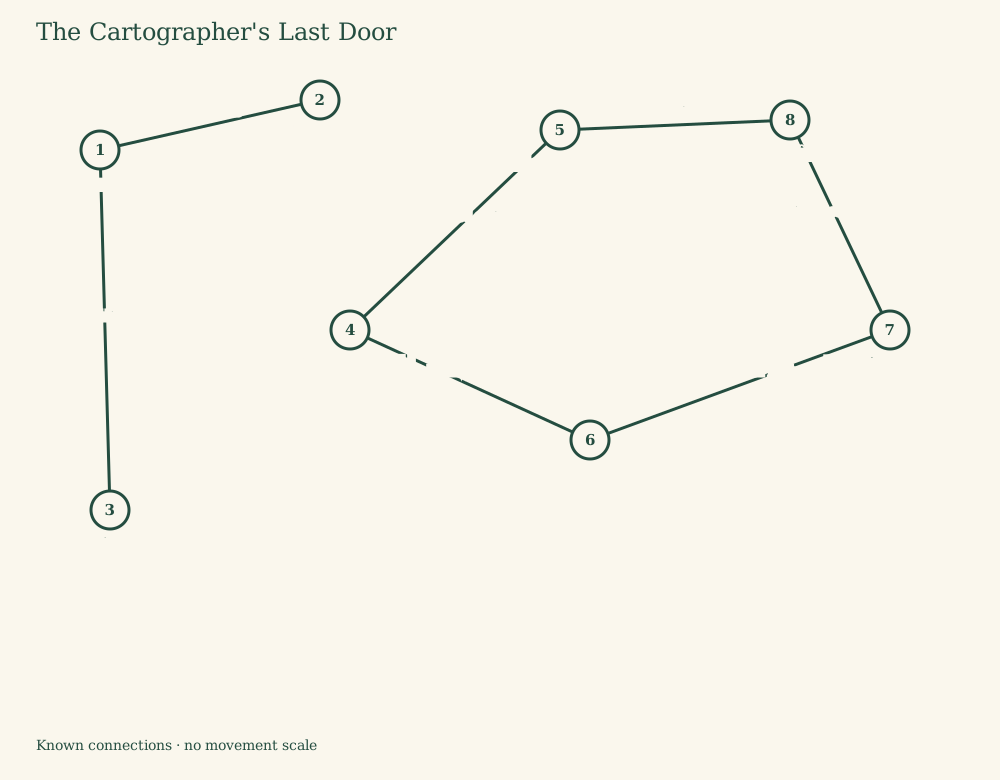
A first look
Dena holds the town map down with four stones. Between two drawn houses, a tiny door stands open. A road fades beneath her finger. From inside the page comes a voice: “Please keep the edge steady.”
Inside your pack
- 9 authored places and 11 connections, with a separate GM decision map.
- 4 NPC cards with goals, offers and boundaries.
- 4 discovery cards with something players can compare, arrange or decide.
- 3 possible closures, including a partial result when the preferred plan fails.
- A one-page GM reference, complete GM book, public player book and state sheet.
- PDF, self-contained HTML and SVG files for offline use.
Two complete routes
90 minutes: Follow the named line
Use map → stone → road → court → road → stone → map. The named shortcut skips the index, so there is no saved tracing unless one of the six work turns is spent detouring to obtain it.
120 minutes: Map the missing places before deciding
Use ink → map → threshold → index → bridge → road → margin → threshold → map. The optional milestone and courtyard consume two additional turns and allow full recognition instead, using the two remaining ink measures.
Read the full GM book — contains spoilers
The Cartographer's Last Door
120-minute plan · 4 players · Explore changing places A new door appears on a finished map. Its cartographer went through yesterday; today the map begins erasing the roads behind him. Content notice: Displacement and forgotten journeys. Substitute an omitted trading route for the refugee path if the table prefers; nobody must tell a personal story.
GM overview
The map is a traversable place with real correspondences. The real milestone points to the constant line inside; the index balcony contains fading addresses; the borrowed courtyard demonstrates who the omitted road serves; the blank margin contains the stable reverse of the paper. Players can use the long drawn-road loop without knowing the old name, or discover the milestone shortcut after anchoring the threshold. Ink counters are finite corrections, not a measure of eloquence. Olin can be brought back before any public decision. A full ending writes Shelter Road on both surfaces and gives future travellers a correction space. A provisional tracing records the route without claiming the town has adopted it. Closing the seam gives an honest third ending. Never demand a refugee character’s testimony as an admission price.
What is really happening
Olin omitted the refugee path he once used. The omission has become a paper door and is erasing the nearest roads. The old milestone preserves its public name, Shelter Road. Recognising the path on both its signpost and the town map restores the roads; folding the door preserves the old map while leaving the omission unresolved.
Opening agreement and read-aloud
Agree on subjects to soften or skip. Each player names an ordinary skill and a reason to help. Evidence does not require a successful roll; uncertainty changes time, cost or obligations. Dena holds the town map down with four stones. Between two drawn houses, a tiny door stands open. A road fades beneath her finger. From inside the page comes a voice: “Please keep the edge steady.”
Time and preparation
120 minutes: Map the missing places before deciding Opening agreement: 10 minutes Budget corrections in the real town: 20 minutes Discover the margin and compare interior paths: 25 minutes Save addresses and reach the cartographer: 30 minutes Return with a clearly provisional record: 25 minutes Closure and debrief: 10 minutes Use ink → map → threshold → index → bridge → road → margin → threshold → map. The optional milestone and courtyard consume two additional turns and allow full recognition instead, using the two remaining ink measures. Starting information: Discover cards in play Starting state: Work turns before more roads fade = 8; Permanent ink measures = 3; Seam fixative = 1; Map edge anchored = false; Shelter Road name recovered = false; Blank-margin return found = false; Olin ready to return = false; Public use of the road recorded = false; Road sign written = false; Provisional tracing saved = false With 4 players: share the roles of mapper, evidence keeper, speaker and timekeeper.
If the group gets stuck
If index-to-viaduct is blocked, threshold → courtyard → road remains open. If the courtyard branch fails, find-margin discovers a stable bypass. Exhausted ink removes full adoption but leaves a previously saved tracing or the unconditional weighted-seam ending.
Map room
Read aloud: Dena keeps one hand on the page. The map’s printed border is the only line that has not faded. GM: Anchor the edge here. The door stays usable without a skill roll once anchored. Final decisions are made at the public map, after Olin returns.
Choice: Weight the edge and appoint a watcher
Ask: Who remains responsible for keeping the real map flat? Requires: Available. Map edge anchored: true Result: The paper door holds a stable human-sized opening.
Choice: Add the road to the public map
Ask: Who checks the two surfaces agree before the ink dries? Requires: Road sign written is true and Olin ready to return is true. Spend 1 Permanent ink measures Result: The name appears on both map and sign; the surrounding roads stop fading. Closure: A road with room for corrections
Choice: Return Olin and preserve a provisional route record
Ask: What notice makes clear that this record still needs public adoption? Requires: Olin ready to return is true and Provisional tracing saved is true. Spend 1 Seam fixative Result: The seam closes beside a dated tracing. The old map survives and the omitted route has a record, though it is not yet adopted. Closure: The record beside the closed seam
Ink shop
Read aloud: Kit catches a wandering drop before it leaves the nib. “Three corrections. One closed seam. Choose what each should preserve.” GM: The ink inventory is already in state; asking Kit reveals the distinction between recording a route and sealing it away. Supplies are finite, with no secret extra bottle.
Choice: Lay out ink and fixative
Ask: Reserve counters for the jobs you want to keep possible. Requires: Available. Reveal Three marks and a seam Result: Three permanent marks and one seam closure are all the supplies available.
Old milestone
Read aloud: Uma brushes a stone until two words and an arrow become visible. Under them someone carved, “We came this way.” GM: Recover Shelter Road and the constant line here. Once the threshold is anchored, knowing the name opens the direct stone-to-road correspondence.
Choice: Recover the public name and arrow
Ask: What makes this a shared road rather than a private memorial? Requires: Available. Spend 1 Work turns before more roads fade. Shelter Road name recovered: true. Reveal Milestone rubbing Result: Shelter Road is legible. The stone line now gives a direct route to the blank sign.
Paper threshold
Read aloud: Footprints in dark ink lead between folded walls. The map edge behind you looks like the horizon. GM: The ordinary route leads to index or courtyard. A rubbing beneath the sill reveals the blank margin return, which is shorter than retracing the drawn road.
Choice: Read the underside of the threshold
Ask: Where can an undrawn path remain when drawn roads fade? Requires: Available. Spend 1 Work turns before more roads fade. Blank-margin return found: true. Reveal Rubbing from the door sill. Discover Blank margin Result: A broad blank margin opens behind the sill.
Index balcony
Read aloud: Numbers remain after the names disappear. One empty line has never had either. GM: Copying threatened addresses costs one ink and one turn; it creates the provisional tracing needed for a partial archive ending. It does not fix the source of erasure.
Choice: Save a tracing of the threatened addresses
Ask: Which three ordinary destinations must the temporary sheet preserve? Requires: Available. Spend 1 Work turns before more roads fade; Spend 1 Permanent ink measures. Provisional tracing saved: true Result: A dated tracing preserves routes as evidence; it is not yet an adopted map.
Borrowed courtyard
Read aloud: Small arrows point from three doors to a path that ends at the same blank sign. GM: Inspecting the courtyard proves the path serves several households, not just Olin’s private memory. Record the use card; no absent resident is impersonated or made to consent.
Choice: Trace the common path between households
Ask: Keep the line outside private doorways and show whom it serves. Requires: Available. Spend 1 Work turns before more roads fade. Public use of the road recorded: true. Reveal Courtyard route sketch Result: The route’s everyday shared use is recorded.
Unfinished road
Read aloud: Olin holds the sign upright. “I drew all the roads I could bear to name. That was not the same as all the roads.” GM: Olin returns willingly when an anchored route exists. Writing the sign requires the recovered public name and observed public use, and costs one ink. It does not itself rewrite the town map.
Choice: Show Olin the anchored return
Ask: Will he carry the blank sign back or help label it here? Requires: Map edge anchored is true. Spend 1 Work turns before more roads fade. Olin ready to return: true Result: Olin joins the group, ready to return by any open anchored route.
Choice: Name the sign Shelter Road
Ask: What space will you leave for a later traveller’s correction? Requires: Shelter Road name recovered is true and Public use of the road recorded is true. Spend 1 Permanent ink measures; Spend 1 Work turns before more roads fade. Road sign written: true Result: The public name appears on the sign. The corresponding blank on the town map still waits.
Blank margin
Read aloud: Nothing here is drawn, so nothing here can be erased. Your shadows remain ordinary. GM: Discover at the threshold. This constant return bypasses the index and courtyard, joins the road, and can recover Olin when either drawn branch is blocked.
Folded viaduct
Read aloud: The bridge bends without tearing. Its handrail is an unbroken sentence that leads toward the signpost. GM: The route index → viaduct → road offers a northern approach. Reading the rail explains that names can be added without replacing existing streets; taking a rubbing gives no extra ink.
Connections and changing routes
Map room ↔ Ink shop: Town lane. Available. Map room ↔ Old milestone: Old public path. Available. Map room ↔ Paper threshold: Anchored paper door. Map edge anchored is true. Paper threshold ↔ Index balcony: Numbered stair. Available. Index balcony ↔ Folded viaduct: Folded viaduct. Available. Folded viaduct ↔ Unfinished road: Signpost descent. Available. Paper threshold ↔ Borrowed courtyard: Doorway lane. Available. Borrowed courtyard ↔ Unfinished road: Shared water path. Available. Paper threshold ↔ Blank margin: Reverse-of-page opening. Blank-margin return found is true. Blank margin ↔ Unfinished road: Constant blank edge. Blank-margin return found is true. Old milestone ↔ Unfinished road: Named milestone shortcut. Map edge anchored is true and Shelter Road name recovered is true.
Dena — Town map custodian
Goal: Save usable roads and let corrections remain visible. Offers: Weights, a public map and a space for amendments. Will not accept: Will not call an unadopted sketch an official route. Voice: Ask which surface the change appears on.
Kit — Ink seller
Goal: Use the last permanent measures deliberately. Offers: Three ink measures and one fixative jar, already counted. Will not accept: Cannot replace spent ink during the session. Voice: Touch one bottle for each promised mark.
Uma — Milestone keeper
Goal: Keep the old path visible for travellers. Offers: The public road name and a rubbing; no private testimony required. Will not accept: Will not agree that one man owns the path because he remembers it. Voice: Quote the stone, then point toward ordinary homes.
Olin — Cartographer
Goal: Return and acknowledge what he omitted. Offers: Carries the signpost and leaves room for future map corrections. Will not accept: Needs a stable return route before leaving the paper road. Voice: Admit an omission without demanding comfort.
Discovery card: Three marks and a seam
Give only when revealed in play. Permanent ink: three measures. A sign uses one; the public map uses one; a tracing uses one. Fixative closes the existing seam but cannot write a road. Put counters beside the jobs you choose. Player task: Budget the map work before spending any ink. GM answer: A full record costs two measures; a provisional tracing costs one; folding needs only the fixative.
Discovery card: Milestone rubbing
Give only when revealed in play. SHELTER ROAD. Arrow follows the constant stone line. Beneath: WE CAME THIS WAY. The words are old and public; the arrow reaches the empty signpost in the paper. Player task: Match the arrow to the interior road and place the name on a proposed sign. GM answer: With the edge anchored, the milestone becomes a discovered shortcut directly to Olin.
Discovery card: Courtyard route sketch
Give only when revealed in play. Door A → shared basin. Door B → shared basin. Door C → shared basin. All three continue to the blank signpost. None crosses another household’s doorway. Space for a public route label: ____ . Player task: Explain whom the route serves and keep the path in common space. GM answer: The route has shared public use; recognition is not a private dedication to Olin.
Discovery card: Rubbing from the door sill
Give only when revealed in play. Turn toward the unprinted side, follow the untouched margin, emerge beside the empty sign. Never redraw a fading street to make it an anchor; the border already is one. Player task: Trace an independent return route and mark it on the map. GM answer: The discovered margin bypasses both the index and courtyard; it is a recovery path if a drawn edge is lost.
State sheet
Work turns before more roads fade: 8 (clock, minimum 0, maximum 8) Permanent ink measures: 3 (resource, minimum 0, maximum 3) Seam fixative: 1 (resource, minimum 0, maximum 1) Map edge anchored: false (flag) Shelter Road name recovered: false (knowledge) Blank-margin return found: false (knowledge) Olin ready to return: false (flag) Public use of the road recorded: false (knowledge) Road sign written: false (flag) Provisional tracing saved: false (flag)
Event: Another familiar name pales
Trigger: Work turns before more roads fade at most 2 A nearby street name pales. State the remaining marks and offer recognition, a saved tracing, or a weighted seam closure; do not remove the constant return.
At any place: Call Olin along the constant line and close the seam
Name the omission that the town still needs to address. Requires: Available. Olin ready to return: true Dena and Uma hold the constant edge while Olin returns. The door is folded under the map weights; the omitted road remains unrecognised.
Ending: A road with room for corrections
Requires: Road sign written is true Shelter Road joins the public map without displacing any existing street. Olin leaves blank space for the next person who knows something the map does not. Next: Uma and Dena invite ordinary route corrections at the map room.
Ending: The record beside the closed seam
Requires: Provisional tracing saved is true Olin returns and the old roads survive. A dated tracing preserves the unresolved route; the town has evidence to consider, not a false claim that adoption already happened. Next: Dena schedules an open map review using the tracing and milestone rubbing.
Ending: The fifth map weight
Requires: Available The weighted seam closes and Olin returns. Existing roads recover, but the shared path is still missing. Uma continues to clean the milestone. Next: Decide who will return to the question when fear of losing the map has passed.