90 or 120 minutes · 3–5 players · System-neutral
The Town That Moved Overnight
Buildings have traded places overnight. Before the clinic opens, three signboards and a surveyor’s HOLD latch must make the town usable.
A first look
Ada opens the bakery door onto the clinic waiting room. A fountain stands on dry paving. At the old signpost, neighbors hold three blank boards and ask where the first appointment should go.
Inside your pack
- 6 authored places and 8 connections, with a separate GM decision map.
- 4 NPC cards with goals, offers and boundaries.
- 3 discovery cards with something players can compare, arrange or decide.
- 3 possible closures, including a partial result when the preferred plan fails.
- A one-page GM reference, complete GM book, public player book and state sheet.
- PDF, self-contained HTML and SVG files for offline use.
Two complete routes
90 minutes: Make the clinic reachable first
Original orientation is already marked. Five turns support a core plan; salvaging and posting a market sign consumes the two turns needed to complete restoration before opening.
120 minutes: A fourth sign at a real time cost
The extra time can fund salvage and a market sign while retaining the new layout. Studying the original arrows as well uses the remaining spare turn and makes that combined plan too late; choose which civic benefit matters.
Read the full GM book — contains spoilers
The Town That Moved Overnight
120-minute plan · 4 players · Make time and supplies count Buildings have traded places overnight. Before the clinic opens, three signboards and a surveyor’s HOLD latch must make the town usable. Content notice: Disorientation and moving buildings. Residents remain safely outside while blocks move; no injury is required.
GM overview
Use a seven-turn appointment clock and three signboards. Pulling HOLD costs one turn. A continuous clinic route costs two boards and a turn after HOLD. Restoring the anchors additionally requires studying the scratched arrows and spending the final board on a temporary closure notice. Keeping the new layout instead spends that board on the public address plan. An optional market route uses a board and a turn, so it demands salvaging a fourth board at the old signpost; salvage itself costs another turn. At one remaining turn the first appointment arrives and the complete opening plans close, leaving a manual escort service as the honest partial outcome. Tessa does all physical grid work under HOLD; players make the civic allocation and map decision.
What is really happening
Tessa transposed NORTH and EAST labels on a civic rearrangement grid. HOLD stops motion. Restoring the labels returns the old blocks, while a published new address plan can instead stabilize the altered layout. Either plan must make the clinic reachable first.
Opening agreement and read-aloud
Agree on subjects to soften or skip. Each player names an ordinary skill and a reason to help. Evidence does not require a successful roll; uncertainty changes time, cost or obligations. Ada opens the bakery door onto the clinic waiting room. A fountain stands on dry paving. At the old signpost, neighbors hold three blank boards and ask where the first appointment should go.
Time and preparation
120 minutes: A fourth sign at a real time cost Opening agreement: 10 minutes Inspect the grid and hear changed journeys: 30 minutes Allocate signs and make the clinic route: 40 minutes Choose a permanent map and public oversight: 30 minutes Closure and debrief: 10 minutes The extra time can fund salvage and a market sign while retaining the new layout. Studying the original arrows as well uses the remaining spare turn and makes that combined plan too late; choose which civic benefit matters. Starting information: Three boards before opening Starting state: Turns before clinic opening = 7; Blank signboards = 3; Original anchor orientation known = false; HOLD engaged = false; Clinic route posted = false; Market route posted = false; First appointment has arrived = false With 4 players: share the roles of mapper, evidence keeper, speaker and timekeeper.
If the group gets stuck
A missing board or missed appointment leads to manual escorts under HOLD. The escort ending consumes volunteer time and leaves permanent addresses unresolved. If the direct square–anchors arc closes, reach anchors through the shed baseline.
Displaced square
Read aloud: Ada holds a tray while a patient checks the wrong number. GM: Show the three-board card. A usable clinic route is a real requirement under either civic map choice.
Choice: Post the continuous clinic route
Ask: Use two boards to connect the fixed signpost to the actual clinic? Requires: HOLD engaged is true. Spend 1 Turns before clinic opening; Spend 2 Blank signboards. Clinic route posted: true. Reveal Three boards before opening. Discover The reachable clinic door Result: Neighbors can follow two visible turns to the clinic door.
Choice: Post an optional market route
Ask: Spend one board and one turn serving the market too? Requires: HOLD engaged is true. Spend 1 Turns before clinic opening; Spend 1 Blank signboards. Market route posted: true Result: The market gets its own direction sign, leaving fewer boards for the final plan.
Choice: Publish the agreed new addresses
Ask: Use the final board to keep HOLD and adopt the new layout? Requires: HOLD engaged is true and Clinic route posted is true and First appointment has arrived is false and Turns before clinic opening at least 3. Spend 1 Turns before clinic opening; Spend 1 Blank signboards Result: Residents write the new addresses beside the fixed signpost. Closure: A town with new addresses
Survey shed
Read aloud: One arrow runs through its own painted letter. GM: Comparing the scratch directions reveals the transposition. Knowledge permits restoration but does not pull HOLD or post a route.
Choice: Compare the scratched anchor arrows
Ask: Which socket matches each original direction? Requires: Available. Spend 1 Turns before clinic opening. Original anchor orientation known: true. Reveal Scratched survey arrows Result: Niko marks the original NORTH and EAST sockets on the plan.
Old signpost
Read aloud: Brin taps the post: the paving beneath it has not moved. GM: One reusable board can be salvaged for a turn. It is the only extra sign; repeated salvage is unavailable.
Choice: Salvage the old spare sign
Ask: Spend one turn for the only extra board? Requires: Available. Spend 1 Turns before clinic opening. Blank signboards: +1 Result: Brin turns the old panel over. One additional blank face is available.
Grid centre
Read aloud: Tessa watches two blocks slide one paving stone, then stop. GM: HOLD arrests motion, enabling route marking and later restoration. It does not itself settle public addresses.
Choice: Ask Tessa to engage HOLD
Ask: Freeze the blocks before posting routes? Requires: Available. Spend 1 Turns before clinic opening. HOLD engaged: true. Reveal HOLD and public routes Result: The chalk stops sliding. The present layout holds still.
Anchor stones
Read aloud: The scratched arrows point in directions the labels deny. GM: Restoration requires the learned orientation, HOLD and a clinic route. Keeping the new map can instead be completed at the public square.
Choice: Restore the original labels under HOLD
Ask: Use the final board for a closure and return the blocks to their old places? Requires: Original anchor orientation known is true and HOLD engaged is true and Clinic route posted is true and First appointment has arrived is false and Turns before clinic opening at least 3. Spend 1 Turns before clinic opening; Spend 1 Blank signboards Result: Tessa follows the scratched arrows while neighbors maintain the clinic route. Closure: Familiar doors, shared oversight
The reachable clinic door
Read aloud: A continuous pair of signs finally ends at the waiting room. GM: Posting the clinic route reveals this destination. Visitors can then reach it from the square or the held anchor side. The room is a concrete check on the public route, not evidence that the rest of town has been mapped.
Connections and changing routes
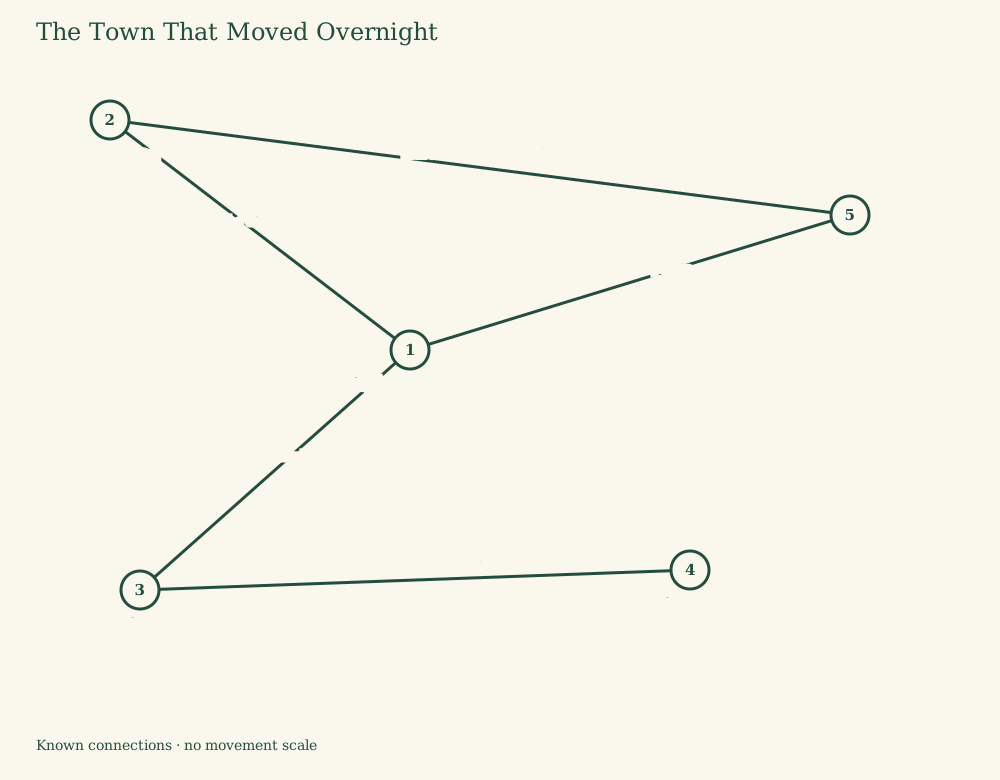
Displaced square ↔ Survey shed: Cross the displaced lane. Available. Displaced square ↔ Old signpost: Follow the steady boundary. Available. Displaced square ↔ Anchor stones: Walk the marked public arc. Available. Old signpost ↔ Grid centre: Follow the outer chalk line. Available. Grid centre ↔ Anchor stones: Use the held-block service way. HOLD engaged is true. Anchor stones ↔ Survey shed: Trace the survey baseline. Available. Displaced square ↔ The reachable clinic door: Follow the posted clinic route. Clinic route posted is true. Anchor stones ↔ The reachable clinic door: Enter from the held anchor side. Clinic route posted is true and HOLD engaged is true.
Ada — Bakery and clinic neighbor
Goal: Get the first patient to the actual clinic Offers: Three boards and neighbors to hold them. Will not accept: A map debate cannot erase the appointment. Voice: “First draw the way to this door.”
Brin — Signpost keeper
Goal: Give people a steady point of reference Offers: One salvageable board and manual escorts. Will not accept: Will not direct anyone through moving blocks. Voice: “Start where the ground stays still.”
Tessa — Surveyor
Goal: Stop motion and accept public control Offers: HOLD, anchor work and the grid key. Will not accept: Changes happen only with the block held and the clinic route posted. Voice: “I can move the labels. You choose the map.”
Niko — Survey apprentice
Goal: Match the scratched arrows with their original sockets Offers: The ridge-and-river comparison and a marked plan. Will not accept: Will not change anchors before HOLD and the clinic route. Voice: “The scratch stayed true when the paint moved.”
Discovery card: Three boards before opening
Give only when revealed in play. Clinic route: two boards. Anchor restoration closure: one board. New address plan: one board. Optional market route: one board. One old sign may be salvaged for a work turn. Lay out a complete plan. Player task: Allocate boards and identify the cost of serving the market too. GM answer: Either core plan uses three. Market service requires the one salvage and its extra time.
Discovery card: Scratched survey arrows
Give only when revealed in play. Northern socket: scratch points toward the ridge. Eastern socket: scratch points toward the river. The painted NORTH label presently sits at the river. The EAST label sits at the ridge. Player task: Mark a proposed correction on the two sockets. GM answer: The two labels are transposed. Learn this, engage HOLD, and protect the clinic path before restoring.
Discovery card: HOLD and public routes
Give only when revealed in play. Under HOLD the blocks stay where they are. Before changing labels: post the clinic route and a closure notice. To keep the new layout: post the clinic route and new addresses. The old signpost remains fixed. Player task: Compare the two complete plans with the available boards. GM answer: Both map decisions are legitimate; the difference is restored places versus retained new addresses.
State sheet
Turns before clinic opening: 7 (clock, minimum 0, maximum 7) Blank signboards: 3 (resource, minimum 0, maximum 4) Original anchor orientation known: false (knowledge) HOLD engaged: false (flag) Clinic route posted: false (flag) Market route posted: false (flag) First appointment has arrived: false (flag)
Event: The first appointment arrives
Trigger: Turns before clinic opening at most 1 The first patient reaches the old signpost. Finish with manual escorts if the complete opening plan is not ready. First appointment has arrived: true
At any place: Count the signs and appointment turns
Check the whole route before using another board? Requires: Available. Reveal Three boards before opening The remaining boards and opening time are visible to everyone.
At any place: Freeze movement and organize manual escorts
Defer the map decision and guide each visitor in person? Requires: Available. HOLD engaged: true Tessa engages the safety hold while Brin leads a temporary escort service.
Ending: Familiar doors, shared oversight
Requires: HOLD engaged is true and Clinic route posted is true and Original anchor orientation known is true The old blocks return under a controlled closure. The clinic opens along its posted route and the grid key passes into public care. Next: Who must approve the next proposed rearrangement?
Ending: A town with new addresses
Requires: HOLD engaged is true and Clinic route posted is true The new layout stays fixed. Neighbors adopt a public address board, accepting longer familiar journeys in exchange for avoiding another move. Next: Which changed route should the next map revision improve?
Ending: A person at each uncertain turn
Requires: Available Movement stops and volunteers guide clinic visitors in person. The permanent map remains undecided and the escort service consumes people’s morning. Next: What would let the escorts return to their own work?