90 or 120 minutes · 3–5 players · System-neutral
The Ferry to the Paper Island
A paper island folds out of the river every summer. This year its ferry has not returned, and the island’s edge is curling toward the water.
A first look
The ferry’s mooring rope ends in a neat paper knot. Nell watches a white shore curl on the horizon. A little paper crane drifts back carrying two words: “Still dry.”
Inside your pack
- 8 authored places and 12 connections, with a separate GM decision map.
- 4 NPC cards with goals, offers and boundaries.
- 5 discovery cards with something players can compare, arrange or decide.
- 3 possible closures, including a partial result when the preferred plan fails.
- A one-page GM reference, complete GM book, public player book and state sheet.
- PDF, self-contained HTML and SVG files for offline use.
Two complete routes
90 minutes: Copy, support, restore
Use quay → shop → landing → terrace → awning, then return via landing → shop → quay. Seven turns permit the five-turn repair-and-boarding route; spending two on reconstruction after a copied pattern is unnecessary and should be declined.
120 minutes: Explore the island and choose what to save
Use quay → reeds → landing → awning → terrace → print → loft → awning, then return via landing → reeds → quay. Ten turns allow saving a reconstruction before towing; the island is consciously relinquished while its future pattern survives.
Read the full GM book — contains spoilers
The Ferry to the Paper Island
120-minute plan · 4 players · Explore changing places A paper island folds out of the river every summer. This year its ferry has not returned, and the island’s edge is curling toward the water. Content notice: Fictional water travel and dissolving shelter; nobody falls into the river. This paper magic is not boating guidance.
GM overview
Eight places form a river approach and an island loop. The quay, fold shop and reed bank give preparation choices; landing, awning, crease terrace and print room form the inhabited paper island; the hidden fold loft provides a dry shortcut discovered from the pattern. Six visitors are already safe under the awning; count Cera and the characters separately as crew. Their danger is a shrinking return window, not drowning scenes. Moisture turns are spent on careful work, never on roleplay. Restoration costs a dry pattern, a supported pinhole and two turns of fold work. Towing uses the finite towline and gives up the island while saving the ferry. A standby launch can take people only if all other resources are exhausted. Describe the wet edges as a route boundary, never as a place where a failed roll drops a person.
What is really happening
Cera folded the landing inward to shelter visitors from rain. Soluble ink washed away the return mark. Ori’s dry ledger still has the correct mountain/valley sequence. The dry pinhole can support a careful restoration; the reed channel can tow the ferry home without saving the island.
Opening agreement and read-aloud
Agree on subjects to soften or skip. Each player names an ordinary skill and a reason to help. Evidence does not require a successful roll; uncertainty changes time, cost or obligations. The ferry’s mooring rope ends in a neat paper knot. Nell watches a white shore curl on the horizon. A little paper crane drifts back carrying two words: “Still dry.”
Time and preparation
120 minutes: Explore the island and choose what to save Opening agreement: 10 minutes Mark the reed alternative: 20 minutes Meet the visitors and explore the interior loop: 25 minutes Recover the pattern for another summer: 25 minutes Choose towing and bring the ferry home: 30 minutes Closure and debrief: 10 minutes Use quay → reeds → landing → awning → terrace → print → loft → awning, then return via landing → reeds → quay. Ten turns allow saving a reconstruction before towing; the island is consciously relinquished while its future pattern survives. Starting information: Discover cards in play Starting state: Dry work turns = 10; Dry pattern sheets = 2; Reed towline = 1; Return sequence copied = false; Fold loft found = false; Ferry pole supports pinhole = false; Visitors aboard = false; Return fold restored = false; Ferry brought home = false; Reed channel marked = false With 4 players: share the roles of mapper, evidence keeper, speaker and timekeeper.
If the group gets stuck
If the summer causeway is blocked, the reeds still reach the landing. If the inner bank walk is blocked, a copied or reconstructed pattern reveals the loft. With no sheets, pattern or towline, the standby launch saves people but leaves the ferry and island; do not turn that result into a full recovery.
River quay
Read aloud: Nell writes the number of visitors on the board, then leaves room for the number returned. GM: Finish ferry or restoration endings here. Nell’s standby launch can rescue people but cannot tow the ferry or preserve the island.
Choice: Record a restored island and returned ferry
Ask: Where will next summer’s waterproof pattern be kept? Requires: Return fold restored is true and Visitors aboard is true. Result: The count matches and the summer shore remains in the river. Closure: A summer shore again
Choice: Close the manifest and keep the dry pattern
Ask: What can be rebuilt next summer from the record you kept? Requires: Ferry brought home is true and Visitors aboard is true and Return fold restored is false. Result: The ferry is home. The island dissolves downstream as loose harmless pages. Closure: A ferry wake through loose pages
Fold shop
Read aloud: Ori points to two folds drawn twice, one in blue and one in black. Only the black line has survived a test splash. GM: Copying the dry ledger uses one sheet and one turn, gives the sequence and reveals a fold loft. The ledger is accessible without persuading Ori.
Choice: Copy the black-ink return pattern
Ask: Which mark will you use to distinguish mountain from valley? Requires: Available. Spend 1 Dry work turns; Spend 1 Dry pattern sheets. Return sequence copied: true; Fold loft found: true. Reveal Dry return pattern. Discover Fold loft Result: The dry sequence and upper-fold route travel on your copy; the original stays protected.
Reed bank
Read aloud: Tev parts the reeds. The cranes keep their wings dry until the same sheltered landing. GM: Marking the channel costs one turn and establishes the towing approach. This route reaches the landing even if the ordinary summer causeway is blocked.
Choice: Follow the crane drift through the reeds
Ask: Mark where the towline will attach and what must be left behind. Requires: Available. Spend 1 Dry work turns. Reed channel marked: true. Reveal Crane drift record Result: The sheltered towing route is known.
Paper landing
Read aloud: Cera catches a loose mooring ribbon. “I folded it to keep the rain out. I should have checked what the ink did in rain.” GM: The pole stands here. Supporting the dry pinhole costs one turn and opens the direct terrace shortcut. Cera stays with the group; no separate rescue unlock is needed.
Choice: Support the dry pinhole
Ask: Who holds the pole while another checks the terrace strip? Requires: Available. Spend 1 Dry work turns. Ferry pole supports pinhole: true. Reveal Dry support diagram Result: The direct landing-to-terrace strip lies flat; the wet outer edge is untouched.
Visitor awning
Read aloud: A visitor has made a game of keeping every ticket dry. The whole group answers the count together. GM: Boarding the restored ferry costs one turn after restoration. Towing instead boards everyone here with two turns and the towline; visitors never need to walk on wet edges.
Choice: Count tickets without delaying anyone
Ask: Who keeps the same count for the quay? Requires: Available. Reveal Visitor count and dry tickets Result: Everyone is together under the awning; the group chooses a boarding plan.
Choice: Board from the restored landing
Ask: Compare the aboard count with the dry ticket list. Requires: Return fold restored is true. Spend 1 Dry work turns. Visitors aboard: true; Ferry brought home: true Result: The ferry carries every visitor to its ordinary return mooring.
Choice: Board and tow through the reed channel
Ask: Name the keepsake you leave rather than delay the last passenger. Requires: Reed channel marked is true. Spend 2 Dry work turns; Spend 1 Reed towline. Visitors aboard: true; Ferry brought home: true Result: People board from the dry awning. Tev tows the ferry home while the unsupported island loosens into pages.
Return crease terrace
Read aloud: A blue arrow ends in a smear. The black fibres around the pinhole remain firm. GM: Restore with pattern and pole. A pinned sequence makes the landing face the quay again and stops the curling edge. This is magical paper, so no real origami expertise is assumed.
Choice: Hold mountain, open valley, then release
Ask: Who calls the sequence and who confirms the pinhole stays supported? Requires: Return sequence copied is true and Ferry pole supports pinhole is true. Spend 2 Dry work turns. Return fold restored: true Result: The landing turns toward the quay. The curling edge relaxes into a small shore.
Island print room
Read aloud: Under an unused block, two pressed folds have left their shape in thick paper. GM: If the ledger route was skipped, reconstructing the sequence here costs two turns and one sheet. It grants the same pattern knowledge and identifies the loft from its embossed delivery arrow.
Choice: Reconstruct the return fold from impressions
Ask: Put the impressions in order and test them with the dry copy. Requires: Return sequence copied is false. Spend 2 Dry work turns; Spend 1 Dry pattern sheets. Return sequence copied: true; Fold loft found: true. Reveal Printing-block impressions. Discover Fold loft Result: The pressed shapes replace the washed instruction and identify the upper delivery fold.
Fold loft
Read aloud: The ceiling is also a walkway. Little paper windows show the river without opening into it. GM: The pattern identifies this hidden dry connection. It offers a landing-to-awning shortcut and a route to the print room, avoiding the curling lower bank.
Connections and changing routes
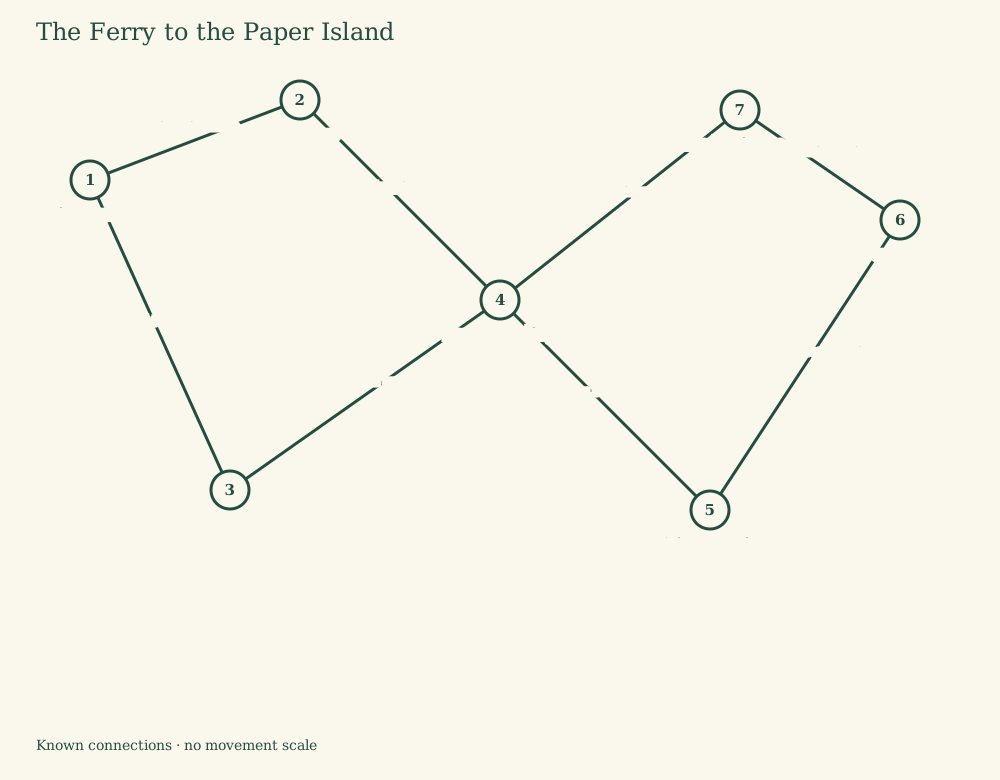
River quay ↔ Fold shop: Riverside lane. Available. River quay ↔ Reed bank: Reed towpath. Available. Fold shop ↔ Paper landing: Summer stepping causeway. Available. Reed bank ↔ Paper landing: Sheltered reed approach. Available. Paper landing ↔ Visitor awning: Inner bank walk. Available. Visitor awning ↔ Return crease terrace: Covered crease stair. Available. Return crease terrace ↔ Island print room: Dry printing bridge. Available. Island print room ↔ Paper landing: Ledger delivery fold. Available. Paper landing ↔ Return crease terrace: Supported pinhole shortcut. Ferry pole supports pinhole is true. Paper landing ↔ Fold loft: Pattern-marked upper fold. Fold loft found is true. Fold loft ↔ Visitor awning: Dry ceiling walk. Fold loft found is true. Fold loft ↔ Island print room: Embossed delivery stair. Fold loft found is true.
Nell — Quay steward
Goal: Bring every visitor back and record the count. Offers: A mooring, passenger board and people-only standby launch. Will not accept: Will not report the ferry recovered when only people return. Voice: Ask for separate counts of people and boats.
Ori — Fold archivist
Goal: Preserve a dry, usable return pattern. Offers: The ledger and two dry sheets. Will not accept: The only ledger stays under glass; copies can travel. Voice: Describe ink by what water does to it.
Tev — Reed pilot
Goal: Use the protected current without loading wet paper edges. Offers: One towline and the sheltered channel. Will not accept: Cannot tow the entire island, and will not attach to a wet edge. Voice: Point to the current before making promises.
Cera — Ferry pilot
Goal: Undo the shelter fold and account for every visitor. Offers: The ferry pole and control of the moored ferry. Will not accept: Board from the dry awning; do not hurry people over the curling bank. Voice: Admit the missing mark and ask for the next concrete step.
Discovery card: Dry return pattern
Give only when revealed in play. Black-ink sequence: hold MOUNTAIN; open VALLEY toward the dry pinhole; release MOUNTAIN last. The dotted delivery arrow climbs into an upper fold before reaching the print room. Blue-ink marks disappear in water. Player task: Order three labelled counters and trace the upper-fold route. GM answer: The pattern restores the return crease and reveals the dry loft shortcut.
Discovery card: Crane drift record
Give only when revealed in play. All three paper cranes enter beside the split reed, pass the still pool, and reach the awning side of the ferry. Towline attaches to the ferry ring, never the island edge. Player task: Draw the towing route and mark what object the line can move. GM answer: The reed current gives a safe alternative approach and rescues the ferry while sacrificing the island.
Discovery card: Visitor count and dry tickets
Give only when revealed in play. Count at the awning: 6 visitors, all present. Crew (Cera and your group) are counted separately. Visitor count aboard: ____ . Visitor count at the quay: ____ . One visitor carries a folding keepsake; it is optional cargo, never a reason to delay a person. Player task: Track the same group through boarding and arrival without inventing missing passengers. GM answer: All people can leave together after a restored landing or through towing; there is no hidden lost visitor.
Discovery card: Dry support diagram
Give only when revealed in play. DRY PINHOLE: place the ferry pole here. WET EDGE: do not pull. With the pole set, the direct terrace strip stays flat; otherwise use the covered awning stair. Player task: Choose the long route or spend a turn opening the direct shortcut. GM answer: Supporting the pinhole is both a repair prerequisite and a useful route discovery.
Discovery card: Printing-block impressions
Give only when revealed in play. First impression: raised mountain held. Second: valley open toward a round hole. Last: raised fold flat. A small delivery arrow points above the room. Player task: Reconstruct a lost sequence from physical impressions and compare it with any ledger copy. GM answer: Two work turns and a dry sheet recover the sequence even without the fold-shop card.
State sheet
Dry work turns: 10 (clock, minimum 0, maximum 10) Dry pattern sheets: 2 (resource, minimum 0, maximum 2) Reed towline: 1 (resource, minimum 0, maximum 1) Return sequence copied: false (knowledge) Fold loft found: false (knowledge) Ferry pole supports pinhole: false (flag) Visitors aboard: false (flag) Return fold restored: false (flag) Ferry brought home: false (flag) Reed channel marked: false (knowledge)
Event: The outer edge curls higher
Trigger: Dry work turns at most 2 The wet outer bank curls. The covered awning and reed approach remain usable; two-turn towing or a people-only launch are the immediate alternatives.
At any place: Request Nell’s people-only launch
What boat or paper structure must the group openly leave for later? Requires: Available. Visitors aboard: true The standby launch collects everyone at the sheltered awning. The ferry remains moored; the island cannot be saved tonight.
Ending: A summer shore again
Requires: Return fold restored is true The valley fold opens cleanly. Every visitor returns, and the island remains a little summer shore with a dry return pattern. Next: Ori and Cera put a waterproof copy at the landing and a second at the quay.
Ending: A ferry wake through loose pages
Requires: Ferry brought home is true The ferry and visitors reach home through the reeds. The island unfolds into pages; the saved pattern gives next summer a beginning, not a completed island. Next: Ask which visitor volunteers to help fold next summer’s landing.
Ending: Every passenger, one boat left behind
Requires: Available The standby launch returns with every visitor. The ferry remains for a daylight recovery and the paper island is lost; Nell records both facts separately. Next: Cera plans the ferry recovery with Tev from the firm riverbank.