90 or 120 minutes · 3–5 players · System-neutral
The Museum's Unwritten Room
An unplanned room opens between two paintings. Objects inside cast the shapes of missing labels, and the museum must decide what it can honestly say about them.
A first look
Rem unfolds a plan showing a wall exactly where a new doorway stands. Through it, a bowl casts a rectangular shadow with the number 47 inside. “We have visitors in an hour,” Rem says. “Do I draw the room, or close the door?”
Inside your pack
- 6 authored places and 8 connections, with a separate GM decision map.
- 4 NPC cards with goals, offers and boundaries.
- 4 discovery cards with something players can compare, arrange or decide.
- 3 possible closures, including a partial result when the preferred plan fails.
- A one-page GM reference, complete GM book, public player book and state sheet.
- PDF, self-contained HTML and SVG files for offline use.
Two complete routes
90 minutes: One object proves the policy
Use the copper bowl as the fully worked example. The other two objects demonstrate the same policy without requiring invented provenance; four intervals cover one reconstruction and both corrections.
120 minutes: Curators, records, and public responsibility
Let players draft and challenge multiple labels, using one shared evidence standard. The extra intervals permit duplicate checking without forcing the museum to conceal the incomplete maker fields.
Read the full GM book — contains spoilers
The Museum's Unwritten Room
120-minute plan · 4 players · Follow the evidence An unplanned room opens between two paintings. Objects inside cast the shapes of missing labels, and the museum must decide what it can honestly say about them. Content notice: Erasure of credit and institutional conflict. The makers and traditions are wholly fictional; uncertainty is a legitimate outcome.
GM overview
This is an inquiry into two different claims: why the room appeared and what can be put on its labels. Keep a table with columns for observed fact, supported inference, and open question. Deleted accession numbers paired with object shadows explain the room. A shipment receipt paired with an old catalogue margin supports “copper bowl, North Kiln workshop, maker not recorded”; neither supports naming the maker. Players may make the museum accountable, open a separate research display, or preserve the room closed. Yara acknowledges the deletions when shown the numbered correspondence; persuasion cannot produce missing maker identities. Give every player an object to describe, but only accession 47 is needed to prove the mechanism. Additional objects follow the same documented policy, not a repeated clue hunt.
What is really happening
Yara removed records with unknown maker names to simplify the exhibition. The museum’s memory has preserved the omitted objects in an unlisted room. Matching accession numbers restores their records; surviving receipts establish materials and workshop locations, but do not establish individual makers. Honest provisional labels integrate the room. Invented names cannot.
Opening agreement and read-aloud
Agree on subjects to soften or skip. Each player names an ordinary skill and a reason to help. Evidence does not require a successful roll; uncertainty changes time, cost or obligations. Rem unfolds a plan showing a wall exactly where a new doorway stands. Through it, a bowl casts a rectangular shadow with the number 47 inside. “We have visitors in an hour,” Rem says. “Do I draw the room, or close the door?”
Time and preparation
120 minutes: Curators, records, and public responsibility Opening agreement: 10 minutes Hear the two curators’ competing needs: 20 minutes Audit omissions against the room: 25 minutes Build a supported label at the conservation store: 25 minutes Agree a public correction and opening policy: 30 minutes Closure and debrief: 10 minutes Let players draft and challenge multiple labels, using one shared evidence standard. The extra intervals permit duplicate checking without forcing the museum to conceal the incomplete maker fields. Starting information: Discover cards in play Starting state: Catalogue work intervals = 6; Supported provisional labels written = false; Omissions publicly acknowledged = false; Surviving duplicate checked = false With 4 players: share the roles of mapper, evidence keeper, speaker and timekeeper.
If the group gets stuck
When one card is unavailable, check-duplicates at the conservation store costs two intervals and supplies recorded knowledge rather than a replacement revelation. The court–store–gallery route bypasses a closed new doorway. Preserve is available from anywhere and explicitly leaves the exhibition incomplete.
Museum hall
Read aloud: The floor plan ends at a wall. Beyond that wall, a copper bowl waits in a room full of label-shaped shadows. GM: Rem controls visitor access and offers preservation immediately. Give the group paper to draft a label before revealing which evidence it will need.
Catalogue desk
Read aloud: Cards marked UNKNOWN MAKER lie under a tidy new index with fewer entries. GM: The deletions are public working records. Yara’s initials document the change but do not establish intent; hear her explanation separately.
Choice: Inspect the deleted accession entries
Ask: Which entries disappeared, and what exactly did the curator remove? Requires: Available. Reveal Revision sheet Result: The three omitted numbers are copied without adding a theory about their makers.
Choice: Record why the room was omitted
Ask: Ask Yara to sign a correction that links the numbered deletions to the objects. Requires: (Revision sheet + Shadow tracing sheet or Surviving duplicate checked is true). Spend 1 Catalogue work intervals. Omissions publicly acknowledged: true Result: Yara signs the public correction and restores the three accession numbers to the index.
Loading court
Read aloud: A packing bill is nailed outside the crate. There is a space for a maker’s name, but nothing has been written in it. GM: Bex supplies the shipment bill freely. He can certify the crate and delivery date; he cannot turn a workshop mark into an individual signature.
Choice: Read the outside of the crate
Ask: What can Bex certify, and what does the blank name field leave open? Requires: Available. Reveal Exterior packing bill Result: The packing bill establishes material, shipment, and the absence of a maker name.
Unwritten room
Read aloud: The bowl’s shadow reads 47. A wooden bird casts 52; a woven mat casts 61. Yara recognizes every number. GM: Tracing the shadows makes the accession match demonstrable. Yara admits removing uncertain entries. Ask whether the group intends a correction, a research display, or closure.
Choice: Trace the numbered shadows
Ask: Pair each shadow with a physical object before explaining the room. Requires: Available. Reveal Shadow tracing sheet Result: Three object numbers match the removed catalogue entries.
Choice: Write labels that preserve the unknown
Ask: Include supported material and workshop facts; leave the individual maker openly unrecorded. Requires: (Exterior packing bill + Old catalogue margin or Surviving duplicate checked is true). Spend 1 Catalogue work intervals. Supported provisional labels written: true Result: The bowl rests over a steady label-shaped shadow. Its maker’s open field remains visible.
Conservation store
Read aloud: A pencilled margin survives where an inked name was never supplied. GM: The old margin supplies the meaning of the kiln mark. If a card is lost, two research intervals compare retained duplicates here and establish the supported facts without fabricating a name.
Choice: Compare the older catalogue margin
Ask: Does the square mark identify a person, a workshop, or only a shipment? Requires: Available. Reveal Old catalogue margin Result: Tali finds the earlier explanation of the workshop stamp.
Choice: Check retained accession duplicates
Ask: Spend two intervals comparing the boxed copies when a working card is missing? Requires: Available. Spend 2 Catalogue work intervals. Surviving duplicate checked: true Result: Tali records the deleted numbers and supported workshop facts from surviving duplicates.
Public display gallery
Read aloud: A visitor points to an empty mount. “Does unknown mean nobody made it?” GM: Open an integrated exhibition only after both supported labels and a public account of the deletion. A separate provisional display needs labels alone, and explicitly leaves the catalogue correction unfinished.
Choice: Open the room on the corrected museum plan
Ask: Display both the provisional labels and the signed account of the omissions? Requires: Supported provisional labels written is true and Omissions publicly acknowledged is true. Result: Rem draws the room onto the public plan and puts the correction at its entrance. Closure: Room for an honest question
Choice: Open a separate provisional research display
Ask: Show the supported labels now and schedule the wider catalogue correction? Requires: Supported provisional labels written is true. Result: Visitors can see the objects and their uncertainties; the incomplete catalogue review is dated on the notice. Closure: A display still doing its research
Connections and changing routes
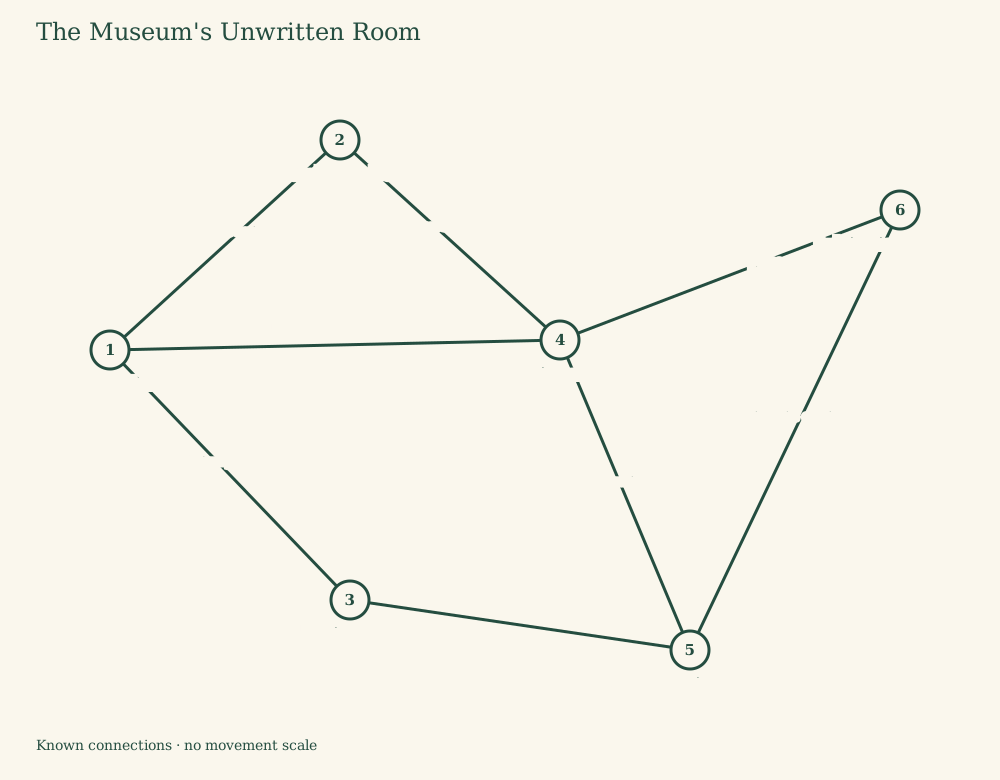
Museum hall ↔ Catalogue desk: Records corridor. Available. Museum hall ↔ Unwritten room: Unplanned doorway. Available. Museum hall ↔ Loading court: Delivery arcade. Available. Catalogue desk ↔ Unwritten room: Curator’s door. Available. Unwritten room ↔ Public display gallery: Empty mount passage. Available. Loading court ↔ Conservation store: Crate ramp. Available. Conservation store ↔ Unwritten room: Conservation door. Available. Conservation store ↔ Public display gallery: Object lift corridor. Available.
Rem — Visitor steward
Goal: Make the public plan accurate before admitting visitors. Offers: A notice stand and controlled access. Will not accept: Will not advertise an unfinished attribution as established. Voice: Asks what a visitor should reasonably understand.
Tali — Records curator
Goal: Restore uncertainty to the catalogue. Offers: Deleted cards, blank labels, and the older index. Will not accept: Will not fill an empty name field with a guess. Voice: “Known how?” said kindly, every time.
Bex — Crate carrier
Goal: Keep the objects connected to their actual shipment. Offers: Packing bill and duplicate archive directions. Will not accept: Can certify delivery, not authorship. Voice: Points to the precise box he signed.
Yara — Exhibition curator
Goal: Preserve the objects and correct her simplifying decision. Offers: Access, an account of the deletion, and a signed correction. Will not accept: Will not invent a maker merely to make the opening look complete. Voice: Begins with polished phrases, then uses plain ones.
Reasoning: The room holds records the catalogue omitted
The same three accession numbers appear in deleted records and beneath retained objects. The room answers a documentary omission. Evidence combinations: Revision sheet + Shadow tracing sheet
Reasoning: Workshop is known; individual maker remains unrecorded
The bill and older explanation independently connect item 47 to the workshop while both leave personal attribution unsupported. Evidence combinations: Exterior packing bill + Old catalogue margin
Discovery card: Revision sheet
Give only when revealed in play. Removed from new index: 47, copper bowl; 52, wooden bird; 61, woven mat. Reason entered for all three: maker field incomplete. Approved Yara. No removal from physical collection recorded. Player task: Match numbers to objects and distinguish removal from a catalogue from removal from custody. GM answer: The omissions concern uncertain attribution, not theft or vanished objects.
Discovery card: Shadow tracing sheet
Give only when revealed in play. Bowl shadow: 47. Bird shadow: 52. Mat shadow: 61. Each rectangle is the size of an accession card. A blank card placed in a shadow stays blank; writing a guess makes the shadow tremble. Player task: Overlay or pair the numbered tracings with the revision sheet. GM answer: The exact deleted numbers explain the new room; an invented name does not restore an honest record.
Discovery card: Exterior packing bill
Give only when revealed in play. Accession 47. One copper bowl. Square kiln stamp. Sent from North Kiln warehouse on 6 Leafmonth. Maker field: not supplied. Delivery accepted by Bex. No personal signature on bowl or bill. Player task: Draft a label using only the recorded material, origin, date, and uncertainty. GM answer: The bill supports the object’s material and shipment history but does not identify its individual maker.
Discovery card: Old catalogue margin
Give only when revealed in play. Square kiln stamp identifies the North Kiln workshop group, not a person. Item 47 matches shipment 6 Leafmonth. Previous label: Copper bowl; North Kiln workshop; individual maker not recorded. Research requests welcome. Player task: Check whether a workshop claim is supported independently, and retain the open maker field. GM answer: Combined with the bill, this supports an honest provisional label and prevents treating a group mark as a personal attribution.
State sheet
Catalogue work intervals: 6 (resource, minimum 0, maximum 6) Supported provisional labels written: false (knowledge) Omissions publicly acknowledged: false (flag) Surviving duplicate checked: false (knowledge)
Event: The first visitor asks about a maker
Trigger: Visit Public display gallery A visitor asks who made the bowl. Invite a player to read the exact label they can defend, including its uncertainty.
At any place: Close with a preservation and research notice
Keep the objects safe and tell visitors which catalogue work remains? Requires: Available. Rem controls access while Tali reserves the numbers and prepares a dated research appointment.
Ending: Room for an honest question
Requires: Supported provisional labels written is true and Omissions publicly acknowledged is true The museum’s plan and catalogue both include the room. Its makers are visible through their work even where their individual names remain unknown. Next: Who is invited to contribute evidence to the open records?
Ending: A display still doing its research
Requires: Supported provisional labels written is true The objects enter a clearly provisional display. Their labels tell the truth, while Yara’s wider catalogue review remains a dated obligation. Next: Choose the review date and the person who checks that it happened.
Ending: A protected room, an unfinished exhibition
Requires: Available The door closes under a preservation notice. The objects stay safe; the empty mounts and explanation keep the unfinished work visible. Next: What first document will Tali seek before the room reopens?